
Refrigerant Recovery Pro is reader-supported: some links on this page are affiliate links, and as an Amazon Associate Refrigerant Recovery Pro earns from qualifying purchases at no extra cost to you. Learn more.
Operating Voltage for swimming pool heat pumps is the amount of electrical pressure, measured in V, required to power the unit. You must identify your property’s available voltage, typically 110V or 220V-240V, before selecting a pool heat pump to ensure the system can draw the necessary power from your home’s electrical grid.
Which Operating Voltage Suits Your Situation?
| If this is you | The Operating Voltage that suits you | Why |
|---|---|---|
| You live in a standard North American residence with a typical household outlet. | 110V | Most standard residential circuits in these regions provide a 110V-120V supply. |
| You live in a region where the standard household supply is higher than 110V. | 220V-240V | Many international regions and specific high-power circuits use this higher voltage. |
| You require a high-capacity swimming pool heat pump for a large volume of water. | 220V-240V | Higher voltage allows the unit to draw more power efficiently to meet high heat demands. |
| You are installing a unit on a dedicated sub-panel or industrial circuit. | 220V-240V | Dedicated high-power circuits are often wired for 220V-240V to support heavy machinery. |
Swimming Pool Heat Pumps covered by our own reviews
3 options shown here, $539 to $1499, each with its own full review behind its name.
If your home setup requires higher voltage, view our list of 220v outlet models.


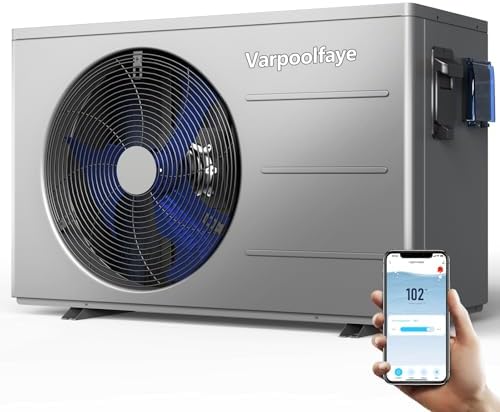
How do you determine your property’s Operating Voltage?
Determining your property’s Operating Voltage involves identifying the electrical supply available at the specific location where the swimming pool heat pump will be installed. You can find this value by looking at the main electrical panel or by checking the labels on existing heavy appliances like a clothes dryer or an electric oven.
It is also vital to understand how to choose your pool volume capacity before purchasing any unit.
Common residential voltage differences for swimming pool heat pumps
Most residential properties in the United States and Canada use a 110V-120V system for standard outlets, while many other countries and specific high-draw appliances use a 220V-240V system. You should check the voltage of the circuit where the heat pump will sit, as the unit must match the supply provided by your home’s wiring. A 110V system is common for smaller units, while a 220V-240V system is standard for larger models that require more power to heat large volumes of water.
Proper circulation depends on your needs, so learn how to choose your pool flow rate correctly.
Why a qualified electrician must confirm pool heat pump amperage
Before ordering, confirm the voltage with a qualified electrician to ensure the circuit can handle the specific amperage requirements of the swimming pool heat pump. An electrician can verify if your current panel has the capacity to support the unit or if a new dedicated circuit needs to be run. It is important to know this before purchase because a 110V swimming pool heat pump will not function on a 220V circuit, and a 220V-240V unit will fail to operate on a standard 110V outlet.
What happens if the Operating Voltage is incorrect?
An incorrect Operating Voltage results in a total failure to power the swimming pool heat pump or a significant risk of electrical damage. If you attempt to run a 220V-240V swimming pool heat pump on a 110V circuit, the motor will lack the necessary electrical pressure to turn. This results in the unit failing to start or the internal components running under-powered, which can lead to overheating and premature component failure.
Understanding the technology is easier when you see the different types of swimming pool heat pumps explained.
Risks of connecting a pool heat pump to mismatched voltage
Conversely, connecting a 110V swimming pool heat pump to a 220V-240V supply provides too much electrical pressure for the internal components. This mismatch can cause the motor to spin at unsafe speeds or result in immediate electrical shorts that blow fuses or damage the control board. In both scenarios, the unit will not produce heat, and the mismatch can lead to costly repairs or the need to replace the entire unit.
New owners should start by reading how a swimming pool heat pump works to understand the basic mechanics.
Costs of purchasing a swimming pool heat pump with incorrect voltage
The cost of this mistake is significant because the swimming pool heat pump may be unusable until the home’s electrical infrastructure is upgraded or the unit is replaced. Because these units are heavy and often require professional installation, a mismatch discovered after delivery can lead to expensive shipping fees for returns or a requirement to hire an electrician to rewire the property. Verifying the V rating before purchase ensures the unit matches your home’s infrastructure.
Safety is a priority, so review the required certifications and safety standards for these systems.
What should you do if your property falls between voltage standards?
If your property falls between voltage standards, you must identify the specific voltage provided by the circuit where the swimming pool heat pump will be installed. In some regions or older homes, the available voltage might be slightly different than the standard 110V or 220V figures. In these cases, you must confirm the exact V rating with a professional before choosing a model.
Verifying local grid stability for specific swimming pool heat pump models
If the available voltage is technically between 110V and 220V, the swimming pool heat pump must be rated for that specific range or be compatible with your local grid’s requirements. You should consult a qualified installer to determine if your local supply is stable and what the specific voltage is at the point of connection. They can tell you if the 110V or 220V-240V options are viable for your specific location.
For a specific high-output option, see our full MICOE MSHP-005Y1 review.
Selecting a swimming pool heat pump that fits available voltage
When requirements conflict, such as wanting a high-capacity unit that usually requires 220V-240V but only having a 110V supply, you must choose a unit that explicitly supports your available voltage. It is better to choose a smaller swimming pool heat pump that fits your 110V supply than to buy a larger unit that cannot be powered. If the available voltage is not clearly stated, a professional electrical survey is the only way to ensure the correct choice.
You can also view our spec breakdown of the KSPF-005L3R1A1 Heat Pump for detailed performance data.
Check your home’s available voltage
Look at the labels on your home’s large appliances, such as a dryer or oven, to see if they are 110V or 220V-240V. If your heavy appliances use 220V-240V, your home likely has the infrastructure for a high-power swimming pool heat pump. If they use 110V, you must ensure the pool heat pump you select is rated for 110V.
Finally, consider the compact performance found in our full AQUASTRONG HEX012-001 review.
Consult an electrician for confirmation
Have a qualified electrician measure the voltage at the exact location where you plan to mount the swimming pool heat pump. They can confirm if the circuit is already rated for 220V-240V or if it is a standard 110V line. This step ensures the unit you buy will function correctly as soon as it is installed.
The other pool heat pump guides we have published
- The Swimming Pool Heat Pumps That Work Best for Above Ground Pools
- Which Swimming Pool Heat Pump Is Best for Inground Pools?
- Best Swimming Pool Heat Pumps for Small Pools
- Swimming Pool Heat Pumps for Large Pools Compared
- Choosing the Best Swimming Pool Heat Pump with Wifi Control
- The Swimming Pool Heat Pumps That Work Best for Heating and Cooling