
Refrigerant Recovery Pro is reader-supported: some links on this page are affiliate links, and as an Amazon Associate Refrigerant Recovery Pro earns from qualifying purchases at no extra cost to you. Learn more.
Static Pressure Capacity for axial blowers should typically fall between 0.5 in. w.g. and 4.0 in. w.g. depending on the resistance of the ductwork and filters. You need to identify the specific resistance of your path to determine the required capacity, as a fan must overcome every inch of friction to move air.
Recommended Static Pressure Capacity by Use Case
| Use Case | Recommended Static Pressure Capacity | Why this number |
|---|---|---|
| General Room Ventilation | 0.25 to 1.0 in. w.g. | Standard ductwork and low-resistance grilles require minimal pressure to move air. |
| Commercial Kitchen Exhaust | 1.0 to 3.0 in. w.g. | Grease filters and long runs create significant resistance that requires higher pressure. |
| Industrial Dust Collection | 3.0 to 6.0 in. w.g. | High-efficiency filters and complex piping demand high pressure to maintain flow. |
| Sub-Slab Depressurization | 0.5 to 2.0 in. w.g. | Soil and gravel resistance vary, but high-pressure fans are often used for deep systems. |
| High-Temperature Drying | 1.5 to 4.0 in. w.g. | Dense filtration media used to trap moisture requires substantial pressure to push air. |
Axial Blowers we have reviewed in detail
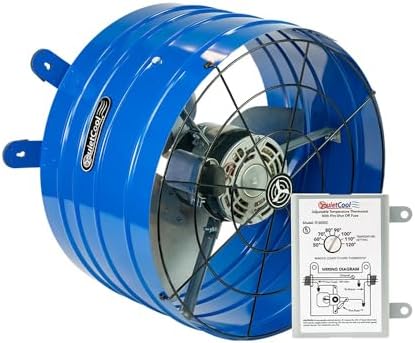
Each of the 3 shown here has its own full review on this site; they run from $147 to $189.
If you are dealing with soil gas, see our guide to the best radon fan for home safety.


What Happens if You Underbuy or Overbuy Static Pressure Capacity
Underbuying static pressure capacity occurs when the axial blower cannot overcome the resistance of the system. If the pressure requirement of your ducting exceeds the fan’s rating, the air volume will drop significantly as the motor struggles against the backpressure. This often leads to motor burnout because the motor works harder to move less air, generating excessive heat. You may notice the fan spinning at high speeds while very little air exits the vent. This is a failure of the system to meet the physical requirements of the path.
For underground moisture issues, browse our comparison of the best crawlspace basement ventilator fan options.
Overbuying axial blower static pressure capacity causes noise and energy waste
Overbuying static pressure capacity results in a mismatch between the fan’s power and the system’s needs. A fan with significantly more pressure than required can move air too quickly through small ducts. This high velocity creates excessive noise and can cause vibration issues in the mounting hardware. It also leads to wasted energy, as you are paying to power a motor that performs far beyond what the application demands. While it ensures the air moves, it often creates a louder, more expensive environment than necessary.
Exterior ventilation requires specific hardware, so check our list of the best wall mounted shutter exhaust fan models.
The Mistake Most Buyers Make with Axial Blower Pressure
Most buyers mistakenly assume that a higher airflow capacity automatically translates to sufficient static pressure. This is incorrect because airflow and pressure are different physical properties of air movement. A high-volume axial blower might move a lot of air in an open space but fail completely when a filter or long duct is added. You should instead optimize for the highest point of resistance in your system. If your filter creates 2.0 in. w.g. of resistance, your blower must exceed that number regardless of how much air it can move in free air.
Smart homes benefit from automation, so look at the best ventilation fan with wifi temperature humidity controller features.
Calculating required axial blower pressure using duct friction and filter data
How much pressure does your specific duct run actually create? You can determine this by measuring the pressure drop across your filters and calculating the friction loss of your duct length. If you do not have the exact data, aim for a fan that provides at least 20% more pressure than your highest resistance point. This buffer ensures the fan can maintain its rated airflow even as filters become loaded with dust or debris over time.
High-moisture areas need lighting, so consider our guide for the best bathroom exhaust fan with led light.
How Static Pressure Capacity Interacts with Other Axial Blower Specs
Static pressure capacity interacts directly with airflow capacity and motor type. In axial blowers, there is a physical trade-off between how much air is moved and how much pressure is generated. A fan designed for high pressure usually has a smaller diameter or a specific blade pitch that limits its maximum airflow. If you require both high pressure and high volume, you may find that a standard axial blower cannot provide both simultaneously.
Large rooftops require significant volume, which you can find in our analysis of the best attic ventilation fan for large spaces.
EC motors provide variable speed control to balance axial blower pressure
The motor type also dictates how the pressure is delivered. AC motors provide constant pressure, while EC motors allow for variable speed control. Using an EC motor allows you to dial in the exact pressure needed, which helps prevent the overbuying issues mentioned previously. This allows the user to find a balance between the air volume required and the pressure needed to push it through the system.
Beyond pressure, you should also evaluate the noise level for axial blowers to ensure a quiet environment.
Balancing fan diameter and static pressure for specific installation geometry
Fan diameter is another interacting factor. A larger diameter fan can move more volume, but it does not inherently mean it can push that volume through a high-resistance path. You must ensure the diameter is sufficient for your volume needs while the static pressure rating handles the resistance. If the pressure is too low, the large fan will simply move no air; if the pressure is high but the diameter is too small, you will not move enough volume. The two specs must be balanced to match the specific geometry of your installation.
New users can learn the basics by seeing how an axial blower works and its core mechanics.
Calculating Resistance for Your Specific Setup
System resistance is the sum of all friction points in your path. This includes the length of the duct, the number of elbows or turns, and the pressure drop across any filters or dampers. Each 90-degree turn in a duct adds a specific amount of resistance that the axial blower must overcome. A long run of ducting creates friction against the inner walls, which increases the pressure required as the distance increases. You must account for every bend and connection in your plan.
For a specialized shutter design, read our full review of the AIRLIFT T10 performance.
High efficiency filters increase the static pressure requirements for blowers
Filters are often the highest point of resistance in a system. A thick, high-efficiency filter will create much more backpressure than a thin mesh. If you plan to use heavy-duty filtration, your static pressure requirement will jump significantly. You must confirm the pressure drop rating of the filter you intend to use before selecting the blower. A fan that works perfectly with a loose screen will fail the moment a dense filter is installed.
If you need a compact bathroom solution, see our full review of the Homewerks 7141-50.
Why High Pressure Can Be Wasted
A high static pressure rating is only useful if the system can actually utilize that pressure. If your ductwork is wide and short, the resistance is low, and a high-pressure blower will simply move air faster than the system can handle. This can lead to “noise pollution” where the air creates a whistling or roaring sound as it exits the vents. In these cases, a lower-pressure fan with a larger diameter is a more efficient choice.
To manage high-volume attic airflow, look at our full review of the Quietcool AFG PRO-2.0.
Increasing duct diameter reduces friction in long and complex air paths
Conversely, if you have a very long duct run with many turns, even a high-pressure fan might struggle if the diameter is too small. The air velocity becomes so high that it creates massive friction, effectively “choking” the flow. In this scenario, increasing the duct diameter is often more effective than buying a fan with a higher pressure rating. You must balance the physical size of the path with the power of the fan to ensure the air reaches the destination.
For a quiet ceiling mount option, view our full review of the WhisperFit FV-0511VFL1.