
Refrigerant Recovery Pro is reader-supported: some links on this page are affiliate links, and as an Amazon Associate Refrigerant Recovery Pro earns from qualifying purchases at no extra cost to you. Learn more.
Axial blowers come in four price levels, with the most common purchase falling between $129.90 and $189.99. As the price rises, the median airflow capacity increases from 110 CFM to 160 CFM while the median price per unit of airflow capacity moves from $1.03 to $1.50.
Axial Blower Price Levels at a Glance
| Price level | Price range | Products | Median airflow capacity | Median noise level | Median rating |
|---|---|---|---|---|---|
| Entry level | $100.87 to $125.80 | 28 | 110 CFM | 1.5 Sones | 4.4 |
| Lower mid-range | $129.90 to $152 | 29 | 110 CFM | 1.5 Sones | 4.4 |
| Upper mid-range | $152.91 to $189.99 | 28 | 110 CFM | 1.5 Sones | 4.4 |
| Top end | $189.99 to $1449 | 29 | 160 CFM | 1.5 Sones | 4.5 |
Products in this category with a full review here
From $147 to $312.99: 3 of the 15 in this category we have reviewed in full.
If you are dealing with underground gases, see how to choose the best radon fan for home safety.


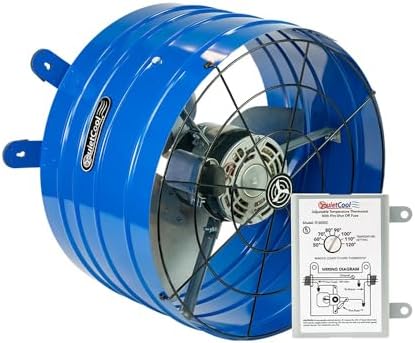
What does an entry level axial blower provide?
An entry level axial blower provides a median airflow capacity of 110 CFM and a median noise level of 1.5 Sones at a median price of $109.99. This price point suits buyers who need basic air movement for small spaces where high-volume output is not a requirement. At this level, you give up the higher airflow capacities found in the top end of the market, which can move up to 160 CFM.
For underground moisture control, browse our list of the best crawlspace basement ventilator fan options.
Entry level axial blowers provide sufficient volume for small scale ventilation
The entry level is suitable for small-scale ventilation where the primary goal is moving air rather than overcoming significant resistance. If you need to move air in a small closet or a small workshop area, these units provide the necessary volume. However, if your application requires moving air through long duct runs or dense filters, an entry level blower may lack the necessary pressure to maintain flow.
To improve exterior airflow, view our guide to the best wall mounted shutter exhaust fan models.
What does a lower mid-range axial blower provide?
A lower mid-range axial blower provides a median airflow capacity of 110 CFM and a median noise level of 1.5 Sones at a median price of $145.90. This level suits users who require a reliable standard fan but do not need the high-volume output of industrial-grade models. Compared to the entry level, you gain a slightly higher price per unit of airflow capacity at $1.27, though the median airflow remains the same.
Mid range axial blowers offer robust construction for consistent garage ventilation
Buyers often choose this range when they need a balance between cost and build quality. While the median airflow capacity remains at 110 CFM, the higher price point often indicates a more robust construction or a motor designed for consistent operation. If you are looking for a fan for a consistent ventilation task in a garage or a large shed, this range offers a stable middle ground before the price jumps significantly for higher-capacity models.
Smart home users should view our comparison of the best ventilation fan with wifi temperature humidity controller features.
What does an upper mid-range axial blower provide?
An upper mid-range axial blower provides a median airflow capacity of 110 CFM and a median noise level of 1.5 Sones at a median price of $164.99. This level suits those who prioritize a specific brand or a particular housing design over raw airflow volume.
For moisture-prone rooms, find our guide to the best bathroom exhaust fan with led light styles.
Higher mid range axial blowers provide specialized features for specific environments
In this price bracket, the jump in performance is often less about the volume of air moved and more about the specific application of the blower. If you require a blower that can handle specific environmental conditions or provides a particular aesthetic for a workspace, this range provides those options. If your primary concern is simply moving the most air possible for the least amount of money, you may find the lower mid-range more efficient for your budget.
Large structures require specialized airflow, so explore our list of the best attic ventilation fan for large spaces today.
What does a top end axial blower provide?
A top end axial blower provides a median airflow capacity of 160 CFM and a median noise level of 1.5 Sones at a median price of $240.99. This level suits heavy-duty industrial applications or large-scale ventilation projects where high volume is a necessity. At this price, you gain a significant increase in airflow capacity compared to the 110 CFM median found in all lower price brackets.
High performance axial blowers move large volumes of air for large spaces
The top end is where you find the highest performance for air movement. While the price per unit of airflow capacity is at its highest at $1.50, the increased volume allows for much larger spaces to be cleared of heat or fumes. You trade a higher initial cost for a substantial increase in the volume of air moved per minute.
Ensure your installation meets regulations by reviewing the required certifications and safety standards for axial blowers online.
Where does paying more stop buying more for an axial blower?
Paying more stops providing significant gains once you move past the 160 CFM threshold, as the price per unit of airflow capacity continues to rise. The median price per unit of airflow capacity moves from $1.40 in the upper mid-range to $1.50 at the top end. This indicates that you are paying a premium for the highest available volume rather than a linear increase in efficiency.
Different configurations serve different purposes, so learn the different types of axial blowers, explained here.
If your requirements can be met by a 110 CFM fan, spending more than the upper mid-range median of $164.99 does not result in more air movement; it only provides a higher-priced version of the same volume. The gain flattens for most standard applications because the jump from 110 CFM to 160 CFM is a specific performance leap.
Selecting the right size is critical, so see how to choose your fan diameter for axial blowers correctly.
What to budget for on top of the axial blower?
Budgeting for an axial blower requires accounting for the necessary hardware to route and manage the air. You will need to purchase ducting, which channels the air to the desired destination, and ensure the diameter of the ducting matches the outlet of the blower. If the ducting is too small, it creates resistance that can lead to motor burnout.
For a quiet ceiling solution, look at our spec breakdown of the WhisperCeiling FV-0511VQ1 unit.
Essential components and professional installation requirements for axial blower systems
Other necessary components include a backdraft damper, which prevents air from flowing backward when the fan is off, and a mounting bracket to secure the fan to the wall or ceiling. If you need to clean the air, a filter is required to remove particulates from the airflow. Each of these components must be sized to match the blower’s specifications to ensure the system operates correctly. You should also account for the time someone spends on a professional installation, as many high-volume blowers require a qualified installer to ensure proper mounting and safety compliance.
How to tell if an axial blower is a fair price?
A fair price for an axial blower is determined by the price per unit of airflow capacity compared to the category medians. To calculate this, divide the price of the blower by its stated airflow capacity. For example, a fan that moves 110 CFM should ideally cost around $1.03 to $1.40 per CFM, depending on the required build quality.
High-performance cooling is available in our full review of the AIRTITAN T8 model.
Using price per CFM medians to identify overpaying for axial blowers
If you find a blower where the price per unit of airflow capacity is significantly higher than $1.50, it likely includes premium features or a specific brand name rather than raw performance. Conversely, if you find a blower significantly lower than $1.03 per CFM, verify that the airflow capacity is not being overstated or that the motor is not underpowered for the housing size. Use these medians as a baseline to ensure you are not overpaying for the volume of air the fan actually moves.
Solar options are available in our full review of the iLiving Solar Roof Fan system.
Verifying CFM ratings instead of housing size when purchasing axial blowers
A common mistake for buyers is choosing a fan based on the housing size rather than the CFM rating. A larger fan does not always move more air if it lacks the motor power to turn the blades at the necessary speed. Always verify the CFM value before making a purchase to ensure the price aligns with the actual output.
For a durable wall unit, see our full review of the iLIVING Shutter Exhaust Fan model.
Prices were checked in November 2026 and retail prices may move.