
Refrigerant Recovery Pro is reader-supported: some links on this page are affiliate links, and as an Amazon Associate Refrigerant Recovery Pro earns from qualifying purchases at no extra cost to you. Learn more.
Airflow capacity for axial blowers typically ranges from 50 to 6,128 CFM, with a median of 110 CFM. You need to select a capacity that matches the specific volume of air your space requires to move, which varies based on the room size and the speed of the air exchange required.
If you are concerned about gas seepage, see our guide to the best radon fan for home protection.
Recommended Airflow Capacity for Axial Blowers
| Use Case | Recommended Airflow Capacity | Why this number |
|---|---|---|
| Exhaust steam from a large bathroom | 80 to 110 CFM | Calculated to clear moisture from a large bathroom area quickly. |
| Move air in a crawlspace | 100 to 200 CFM | Provides consistent circulation for smaller, enclosed ground spaces. |
| Ventilate a large attic space | 400 to 800 CFM | Derived from the need to cycle air through a high-volume roof area. |
| Industrial high-volume ventilation | 1,000+ CFM | The point where residential fans transition to high-volume industrial requirements. |
Products in this category with a full review here
Each of the 3 shown here has its own full review on this site; they run from $135.99 to $189.
For underground spaces, compare the best crawlspace basement ventilator fan options.
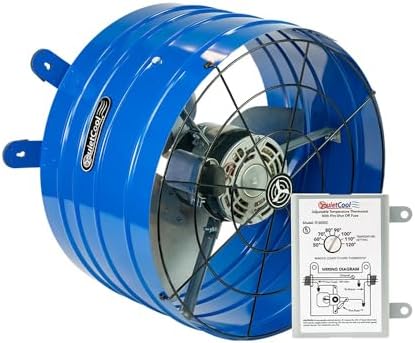


What happens if you underbuy or overbuy Airflow Capacity?
Underbuying Airflow Capacity means the axial blower will not move enough air to achieve your goal, such as clearing steam or cooling a space. If the volume of air moved is too low, moisture remains in the air, heat builds up, or stale air lingers because the fan cannot overcome the time required to cycle the total volume of the room. This often leads to the fan running constantly without ever reaching the desired environment, which can lead to increased humidity or poor air quality over time.
To exhaust air through exterior walls, browse our top picks for wall mounted shutter exhaust fans.
Understanding your budget is essential, so review what axial blowers cost at different price levels.
Overbuying axial blower airflow capacity increases noise and energy costs
Overbuying Airflow Capacity introduces different issues, primarily regarding noise and energy efficiency. While a higher CFM rating means the fan can move more air, an axial blower with an unnecessarily high capacity will move air at a higher velocity than required for your specific space. This high-velocity air can create significant turbulence and noise, similar to how a high-powered leaf blower is much louder than a small handheld fan. Furthermore, a blower with a much higher CFM than you need may consume more electricity than necessary to maintain its operation, leading to higher running costs for a capability you will never use.
To ensure a proper fit, learn how to choose the correct fan diameter for axial blowers.
What is the most common mistake with Airflow Capacity?
The most common mistake buyers make is assuming that a higher Airflow Capacity automatically results in a more effective system regardless of the environment. Many buyers choose a high CFM rating because they believe it will “push” air harder, but Airflow Capacity only measures the volume of air moved per unit of time. It does not measure the force of that air or the ability of the fan to overcome obstacles in the way it travels.
For a deeper look at technology, view the different types of axial blowers explained.
Protect your investment by reviewing what to check in axial blower warranties before you buy.
Balancing axial blower airflow volume with system resistance and pressure
Instead of only looking at the CFM, you should be optimizing for the resistance of your specific setup. If you have long duct runs or high-density filters, a high-CFM fan that lacks sufficient static pressure will struggle to push air through the path. In these cases, the fan might move a high volume of air in “free air” (no resistance), but the actual output in your installation will drop significantly because the air cannot get past the obstructions. You must balance the volume of air you need with the physical path the air must take.
New users should start with an explanation of what an axial blower is and how it works.
How does Airflow Capacity interact with other axial blower specs?
Airflow Capacity interacts directly with Static Pressure Capacity, which is the ability of the fan to overcome resistance in the ductwork or filters. A high Airflow Capacity figure is often wasted if the Static Pressure Capacity is too low to move that volume of air through a restricted path. For example, an axial blower designed for high-volume, low-resistance applications will fail to move any meaningful air if placed behind a heavy-duty particulate filter or a long, narrow duct.
For a specific wall solution, see our full review of the iLiving Shutter Fan.
If you need specialized gas mitigation, view our spec breakdown of the RadonAway RP145C.
Matching axial blower airflow capacity to room size and noise limits
Another interaction involves the Noise Level of the axial blower. Because Airflow Capacity is a measure of volume, increasing the CFM often increases the velocity of the air. Higher velocity air creates more turbulence, which is the primary source of noise in axial blowers. If you choose a fan with a very high Airflow Capacity for a small room, the noise level may become disruptive for indoor living spaces, which typically start to become problematic at the 1.5 Sones threshold. You must verify that the CFM rating of the blower matches the volume of your space while remaining within a noise level that is acceptable for your specific environment.
For high-volume attic cooling, look at our full review of the Cool Attic CX30BD2SPD.
Using EC motors to adjust axial blower airflow for specific needs
Finally, the motor type—such as an EC Motor versus an AC Motor—affects how the Airflow Capacity is delivered. EC motors allow for variable speed control, which lets you dial in the exact CFM needed for your situation rather than being locked into a single high-volume output. This allows you to use a fan with a high maximum Airflow Capacity while running it at a lower, quieter speed that matches your actual requirements, providing a way to balance high-performance specs with practical daily use.
Greenhouse growers can find details in our full review of the Active Air ACDF10.