
Refrigerant Recovery Pro is reader-supported: some links on this page are affiliate links, and as an Amazon Associate Refrigerant Recovery Pro earns from qualifying purchases at no extra cost to you. Learn more.
Rotational speed for centrifugal blowers is the measurement of how many full turns the impeller makes every minute, expressed in RPM. You choose the correct RPM by matching the blower’s speed to the specific volume of air moved per unit of time your application requires without exceeding the noise or vibration limits of your workspace.
For specific safety requirements, see the best centrifugal blower for laboratory fume hood ventilation.
Which Rotational Speed Suits Your Situation?
| If this is you | The Rotational Speed that suits you | Why |
|---|---|---|
| You need to move large volumes of air through very short, open distances. | Lower RPM (1,500 to 1,800 RPM) | Lower speeds reduce noise and vibration while providing sufficient volume for open spaces. |
| You are moving air through long duct runs with multiple bends or high-resistance filters. | Higher RPM (2,200 to 2,600 RPM) | Higher speeds generate the necessary force to overcome the resistance of long-distance piping. |
| You are installing a blower in a residential or office environment where noise is a primary concern. | Lower RPM (1,500 to 1,725 RPM) | Lower rotational speeds minimize the acoustic output of the centrifugal impeller. |
| You are operating an industrial process requiring high-velocity air movement for cooling or drying. | Higher RPM (2,400 to 2,600 RPM) | Higher speeds provide the velocity required for rapid heat exchange or material transport. |
Products in this category with a full review here
Each of the 3 shown here has its own full review on this site; they run from $120.49 to $195.
Quiet operation is critical in many settings, so view the best centrifugal blower for low noise exhaust.
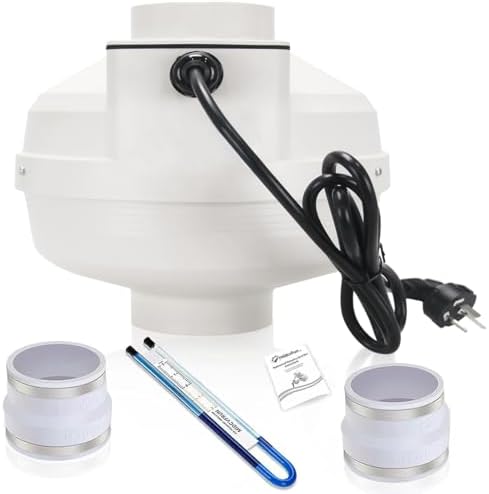


How do you establish the correct Rotational Speed for your centrifugal blower?
Establishing the correct Rotational Speed for a centrifugal blower begins with identifying the required airflow capacity and the total resistance of your system. You must first determine the Cubic Feet per Minute (CFM) required to achieve your goal, such as cooling a room or exhausting a workshop. Once you have the CFM, you must calculate the static pressure, which is the resistance the fan must overcome to move air through your specific ductwork or filters.
Space constraints often dictate your choice, so browse the best centrifugal fan for small spaces.
Locating the rated RPM on manufacturer specification sheets and nameplates
To find the specific RPM value, look for the “Rotational Speed” or “Speed” entry on the manufacturer’s specification sheet. This number is usually listed in RPM. If you are replacing an existing unit, locate the nameplate on the motor or the blower housing. The nameplate will state the rated RPM, which is the speed the motor maintains under its intended load. Match the RPM of the new unit to the rated RPM of the old unit if the airflow requirements remain the same.
For specialized underground safety, see the best centrifugal fan for radon mitigation.
Before ordering, learn about selecting the proper inlet and outlet diameter.
How ducting measurements and pressure requirements dictate blower speed
A buyer might start by measuring the length of their ducting and the diameter of the openings. They then use a calculator to determine the required pressure. Selecting a speed that does not match these requirements results in a unit that fails to move enough air, requiring a costly return and a secondary purchase.
To ensure proper installation, research how to choose the correct motor frame size.
What happens if the Rotational Speed is too high or too low?
You will observe a “lazy” airflow where the intake side of the blower remains clear of air while the output remains stagnant. This failure results in inadequate ventilation, which can lead to overheating of equipment or a buildup of fumes in the workspace.
To ensure compliance with regulations, review the required certifications and safety standards.
Risks of excessive rotational speed including vibration and mechanical failure
If the Rotational Speed is too high, the blower may create excessive vibration and noise that exceeds the limits of your environment. High RPMs increase the centrifugal force on the impeller, which can lead to bearing seizure if the motor is not designed for that sustained speed. You will hear a high-pitched whine or feel significant shaking in the mounting brackets. In extreme cases, excessive speed can cause the blower to operate outside its rated duty cycle, leading to premature mechanical failure of the internal components.
Understanding the mechanics is helpful, so explore the different types of centrifugal blowers.
Choosing a speed that is too high for the ductwork’s capacity is like trying to push a heavy load through a narrow straw; the resistance creates a bottleneck that generates heat and noise rather than movement. If the speed is too low, the air simply lacks the energy to travel the distance, leaving the intended area unventilated.
Beginners can start by learning how a centrifugal blower works.
If a blower isn’t right for your project, see the best centrifugal blower alternatives.
What should you do if your requirements fall between two Rotational Speed values?
When your requirements fall between two Rotational Speed values, you must decide whether to prioritize air volume or noise reduction. If your application is in a space where people work for long periods, choose the lower RPM and consider a larger blower body to compensate for the lower speed. A larger blower can move a high volume of air at a lower RPM because it has a larger surface area to move the air.
For detailed performance data, view our full Radon Fan Kit review.
Selecting higher RPM for velocity or the 1,725 RPM median
If your application requires high velocity and the distance is the priority, choose the higher RPM. In cases where you are unsure, the median value of 1,725 RPM is a common point of balance for many industrial applications. This speed provides a middle ground between high-pressure capability and manageable noise levels. If you fall between two values, check the static pressure rating of the blower; a unit with higher static pressure capacity can often handle a more restrictive system even at a lower RPM.
You can find a detailed breakdown in our Ventilation Fans Blower spec review.
Available centrifugal blower speeds ranging from 1,500 to 2,600 RPM
The research on the 8 centrifugal blowers evaluated shows that the median speed is 1,725 RPM, with the range spanning from 1,500 to 2,600 RPM. If your needs fall in the middle of this range, you have a wide selection of options that balance these competing needs. Always confirm the specific RPM of the unit before ordering, as many models share similar external dimensions but differ in internal motor speeds.
Detailed performance metrics are available in our Fasco B47120 spec breakdown.
Every centrifugal blower guide in this category
- The Centrifugal Fans That Work Best for 4 Inch Ductwork
- Which Centrifugal Blower Is Best for Low Noise Exhaust?
- Best Centrifugal Fans for Small Spaces
- Home Ventilation Centrifugal Blowers Compared
- Choosing the Best Centrifugal Blower Under $300
- Best Centrifugal Blowers for Laboratory Fume Hood Ventilation