
Refrigerant Recovery Pro is reader-supported: some links on this page are affiliate links, and as an Amazon Associate Refrigerant Recovery Pro earns from qualifying purchases at no extra cost to you. Learn more.
A centrifugal blower is a machine that uses a rotating impeller to move air or gas by accelerating it into a high-velocity stream and then converting that velocity into pressure. You need a centrifugal blower when you must move air through a system that creates resistance, such as long duct runs, heavy filters, or complex machinery. You should measure the total static pressure of your system in inches of water gauge (w.g.) to determine if a standard fan or a centrifugal blower is required for your specific application.
Centrifugal blowers maintain high airflow through restrictive industrial systems
Standard axial fans move air in a straight line, similar to a propeller on a boat. They excel at moving large volumes of air over short distances with very little resistance. However, if you place a restrictive filter or a long, winding pipe in front of an axial fan, the air will stall because the fan cannot generate enough pressure to push through the obstruction. A centrifugal blower solves this by pulling air into the center of a spinning wheel and flinging it outward. This design allows the unit to maintain high airflow even when the system creates significant backpressure, making it the standard choice for industrial ventilation, dust collection, and HVAC systems where airflow must remain consistent despite obstacles.
If you are designing a specialized storage area, see our guide to the best centrifugal blower for medicine cabinets.
How a Centrifugal Blower Moves Air
The operation of a centrifugal blower follows a specific mechanical progression to transform rotational energy into pressurized airflow.
To ensure a quiet environment, you can view our roundup of the best centrifugal blower for low noise exhaust.
- The intake process begins as air enters the center of the blower, known as the eye.
- The impeller, which is the rotating component, spins at a high speed to grab the incoming air.
- Centrifugal force flings the air outward toward the edges of the impeller blades.
- The housing, or the outer casing, directs this outward-moving air into a spiral path.
- As the air travels along the curve of the housing, its velocity decreases while its static pressure increases.
- The air exits the blower through a discharge port, now under enough pressure to travel through the intended ductwork or machinery.
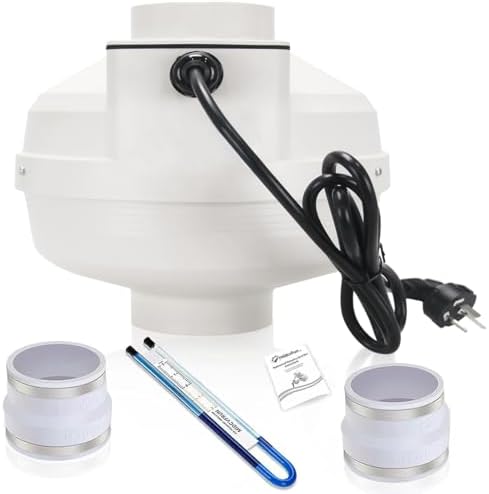
Centrifugal Blowers we have reviewed in detail
Prices across these 3 run from $136.76 to $195; each one has a full review here.


Parts and Standards That Matter to a Buyer
Several internal components and industry standards dictate how a centrifugal blower performs and how long it will last in a specific environment.
Compact installations require specific airflow dynamics, so browse the best centrifugal fan for small spaces.
The Impeller and Housing Design
The impeller determines the airflow volume and pressure capacity of the unit. A larger diameter or a different blade pitch will change how much air the blower can move. The housing dictates the duct connection size and noise attenuation. Because the housing shapes the path the air takes, a well-designed casing reduces the turbulence that creates loud humming or whistling. If you need to connect to a specific pipe size, you must ensure the housing’s outlet matches your existing infrastructure.
Homeowners looking for residential solutions can find the best centrifugal blower for home ventilation.
Bearing Type and Service Life
The bearing type affects the service life and operating temperature limits of the blower. Bearings support the spinning impeller and ensure it stays aligned with the motor shaft. In high-heat environments or applications with heavy loads, choosing high-quality ball bearings or specialized sleeve bearings can prevent the unit from seizing. If a blower is run outside its rated duty cycle, the bearings are often the first point of failure.
Motor Frame Size and Mounting
The motor frame size determines the physical mounting footprint of the blower. This refers to the standard dimensions of the motor housing, which dictates how much space you need on a wall or floor for installation. Selecting a motor that fits your available space is critical for ensuring the unit can be bolted down securely without interfering with nearby equipment.
For basement safety requirements, explore the best centrifugal fan for radon mitigation.
NEMA and IEC Motor Standards
NEMA and IEC motor standards determine electrical compatibility, mounting footprints, and voltage requirements. NEMA is the standard used primarily in North America, while IEC is the standard used in much of the rest of the world. Choosing the wrong standard can mean the motor will not fit the mounting bracket or will not accept the local voltage. You must confirm your local electrical requirements before ordering to ensure the motor matches your power supply.
Industrial safety requirements are strict, so see our analysis of the best centrifugal blower for laboratory fume hood ventilation.
AMCA certification provides verified airflow and static pressure performance
AMCA certification provides the industry standard for verified airflow and static pressure performance. Unlike a manufacturer’s claim, AMCA certification means the unit has been tested by a third party to prove it meets the stated specifications. If your project requires a specific amount of air to be moved at a specific pressure, look for this certification to ensure the blower can actually perform the task.
To better understand technical data sheets, visit our guide to centrifugal blower terms and specs.
What a Centrifugal Blower Changes in Practice
Using a centrifugal blower changes the capability of your ventilation system by allowing for much more complex ducting. In a workshop, for example, a centrifugal blower allows you to run a long exhaust hose to an outside wall while still maintaining enough suction to pull dust away from a machine. Because the blower generates pressure, it can “push” air against the resistance of the hose. In contrast, a standard fan would lose most of its power after only a few feet of hose, leaving the work area dusty.
Centrifugal blower placement allows for better noise management and dampening
The difference also shows up in noise management and placement. Because centrifugal blowers can move air through restrictive paths, you can place the blower further away from the source of the noise. You can move the unit to a sound-dampened area and run the ducting to the work site. This is not possible with high-velocity axial fans, which must be placed close to the source to be effective. However, a centrifugal blower will not provide a higher velocity of air at the point of entry than an axial fan; it provides a more consistent volume of air over a longer distance.
Understanding the different designs is helpful, so look at the different types of centrifugal blowers explained.
How does the airflow compare to other blowers in this price range?
The airflow in a centrifugal blower is determined by its pressure capacity rather than just its motor size. In a similar price range, a centrifugal blower will often provide lower total volume than a large axial fan but will maintain that volume much more effectively against resistance. If your goal is to move air through a long pipe, the centrifugal blower provides more usable airflow than a cheaper axial alternative.
For a detailed performance breakdown, read our full Fasco B24220 review.
Is it worth the price compared to a cheaper generic blower?
A centrifugal blower is worth the price when your application involves any form of resistance like filters, long ducts, or heavy-duty valves. A cheaper generic axial blower might have a higher “max” airflow on the box, but it will fail to move air effectively once you connect it to a real-world system. The extra cost of a centrifugal blower buys the ability to maintain consistent performance under load.
How does the airflow of this unit compare to standard high-velocity fans?
The airflow of a centrifugal blower is designed for volume and pressure rather than high-velocity “jets” of air. High-velocity fans are better for moving air across a wide room quickly or for cooling a specific surface. A centrifugal blower is better for moving a large volume of air through a closed system, such as a furnace or a dust collection hood, where the pressure to move the air is more important than the speed of the air at the exit.
High-volume airflow needs can be met by looking at our full Hurricane Inline Fan review.
Who needs a centrifugal blower and who does not?
You need a centrifugal blower if you are moving air through a system with significant resistance, such as a long duct run, a heavy-duty filtration system, or a closed-loop industrial process. These applications require the high static pressure that only a centrifugal design can provide. If your goal is simply to circulate air in a large, open room with no obstructions, a standard axial fan is likely sufficient and more cost-effective.
You can find a detailed spec breakdown in our full Dayton 1TDR7 review.
Simple fans are more cost effective for low pressure tasks
Conversely, you do not need a centrifugal blower for simple tasks like cooling a small workspace or providing a light breeze in a tent. In these cases, the pressure capabilities of a centrifugal blower are wasted, and the higher cost of the unit provides no practical benefit. If you don’t have to push the air through a pipe or a filter, a simpler fan is the correct tool for the job.
The other centrifugal blower guides we have published
- Best Centrifugal Blowers for Laboratory Fume Hood Ventilation
- Radon Mitigation Centrifugal Fans Compared
- Choosing the Best Centrifugal Blower for Medicine Cabinets
- The Centrifugal Fans That Work Best for 4 Inch Ductwork
- Which Centrifugal Blower Is Best for Low Noise Exhaust?
- Best Centrifugal Fans for Small Spaces