
Refrigerant Recovery Pro is reader-supported: some links on this page are affiliate links, and as an Amazon Associate Refrigerant Recovery Pro earns from qualifying purchases at no extra cost to you. Learn more.
Airflow capacity for centrifugal blowers typically ranges from 50 to 800 CFM depending on the specific ventilation task. You need to select a unit that meets or exceeds these requirements based on the volume of air your space requires to remain safe or comfortable.
Recommended Airflow Capacity by Use Case
| Use Case | Recommended Airflow Capacity | Why this number |
|---|---|---|
| Laboratory fume hood ventilation | 400 to 800 CFM | This range ensures the continuous removal of hazardous vapors from a contained workspace. |
| Whole-home ventilation | 300 to 600 CFM | This volume provides a consistent exchange of indoor air to maintain air quality. |
| Basement radon exhaust | 100 to 300 CFM | This range provides sufficient pressure to move air out of a basement area. |
| Tight crawlspace ventilation | 50 to 150 CFM | Lower volumes are sufficient for the restricted dimensions of a crawlspace. |
Products in this category with a full review here
Each of the 3 shown here has its own full review on this site; they run from $147.66 to $463.21.
If you are designing a laboratory, see our top picks for laboratory fume hood ventilation.


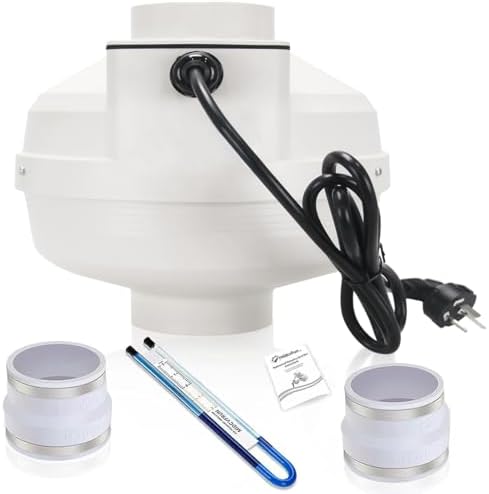
What happens if you under-buy or over-buy Airflow Capacity?
Under-buying airflow capacity means the centrifugal blower cannot move enough air to achieve your goal. If you require 400 CFM for a fume hood but install a unit that only provides 200 CFM, the air will stagnate. This leads to a failure in the primary function of the blower, such as allowing fumes to build up or preventing moisture from escaping a basement.
To maintain a quiet environment, explore the best centrifugal blower for low noise exhaust.
Excess airflow capacity increases noise levels and wastes electricity
Over-buying airflow capacity introduces different risks, primarily involving noise and energy waste. A blower moving significantly more air than needed will create higher decibel levels and consume more electricity than necessary for the task. While it will move the air, the excess capacity results in a less efficient system that may be uncomfortable to operate in a residential or office setting.
Compact installations benefit from viewing our guide to the best centrifugal fan for small spaces.
The mistake most buyers make with Airflow Capacity
The most common mistake is assuming that a higher CFM rating automatically results in better performance for every installation. Buyers often select the highest available number without considering the physical constraints of their ductwork or the distance the air must travel. Because centrifugal blowers are limited by the resistance of the system, a high airflow rating is only useful if the blower has the strength to push that air through the specific path you have designed.
Understanding physical dimensions is easier when you learn how to choose your motor frame size.
Balancing blower airflow capacity with system static pressure requirements
You should focus on balancing the airflow capacity with the static pressure requirements of your specific layout. If you have long runs of tubing or heavy-duty filters, a blower with a high CFM but low pressure rating will fail to deliver the air to the destination. It is more effective to choose a blower where the airflow capacity aligns with the resistance of your chosen path.
You can optimize performance by reviewing how to choose your rotational speed.
How Airflow Capacity interacts with other centrifugal blower specs
Airflow capacity is often limited by the static pressure the blower can generate. Static pressure measures the resistance the fan must overcome to move air through a system, such as through a filter or a long pipe. If your system has high resistance, the actual airflow will drop significantly below the blower’s rated CFM unless the pressure rating is also high.
Ensure your installation meets regulations by viewing the required certifications and safety standards.
How rotational speed and impeller size affect blower noise
Rotational speed also dictates the airflow capacity. A blower’s speed, measured in RPM, determines how many times the impeller turns every minute to move air. Higher RPMs generally result in higher CFM, but they also increase the risk of vibration and noise. If you find a blower with a high CFM rating that is too loud for your environment, you may need to look for a model that achieves its capacity through a larger impeller rather than higher speeds.
New users can start by learning about the different types of centrifugal blowers.
Matching ductwork diameter to blower port size for maximum airflow
Inlet and outlet diameter determine the physical path the air takes into and out of the blower. If the diameter of your ducting does not match the blower’s port size, you create a bottleneck. This restriction limits the effective airflow capacity because the air cannot enter or exit the unit fast enough to reach the rated CFM. Ensuring the port size matches your planned ductwork is essential for the blower to perform as advertised.
For a foundational understanding, see how a centrifugal blower works and what it is.
What do the evaluated centrifugal blowers state for Airflow Capacity?
The centrifugal blowers we evaluated show a range of stated airflow capacities from 135 to 485 CFM. The median airflow capacity among these options is 290 CFM. These figures represent the manufacturer’s stated capability for moving air through the unit under standard conditions.
Detailed performance data is available in our full Radon Fan Kit spec breakdown.
Using manufacturer data as a starting point for airflow calculations
It is important to note that these figures are based on the manufacturer’s data. Because we do not perform physical testing on these units, these numbers should be used as a starting point for your calculations. You should confirm the specific requirements of your space and ensure the chosen blower provides a buffer above your minimum required CFM to account for any resistance in your ductwork.
Technical specifications are available in our full Ventilation Fans Blower comparison.
How to choose the right Airflow Capacity for your needs
To determine your needs, calculate the volume of the space you want to ventilate and the number of air exchanges you want per hour. For example, if you need to move 1,000 cubic feet of air every hour, you need a blower that provides at least 167 CFM. We recommend adding a 20% buffer to this number to account for the pressure drop caused by filters and bends in the ducting.
We provide a deep dive in our full Fasco B47120 spec breakdown.
Choosing a mid-range blower to provide a safe airflow buffer
If you are unsure of the exact requirements, look for a blower that sits comfortably in the middle of the range for your specific use case. For a basement exhaust, a unit in the 200 CFM range provides a safe margin over the minimum requirement of 100 CFM. This ensures that even with some resistance in the piping, the blower will still effectively move the necessary air volume.
Detailed data is provided in our full Fasco B24220 spec breakdown.
Every centrifugal blower guide in this category
- The Centrifugal Fans That Work Best for 4 Inch Ductwork
- Which Centrifugal Blower Is Best for Low Noise Exhaust?
- Best Centrifugal Fans for Small Spaces
- Home Ventilation Centrifugal Blowers Compared
- Choosing the Best Centrifugal Blower Under $300
- Best Centrifugal Blowers for Laboratory Fume Hood Ventilation