
Refrigerant Recovery Pro is reader-supported: some links on this page are affiliate links, and as an Amazon Associate Refrigerant Recovery Pro earns from qualifying purchases at no extra cost to you. Learn more.
Inlet/outlet diameter for a centrifugal blower is the measurement of the opening size where air enters and exits the unit, expressed in inches. You must match this measurement to your existing ductwork or intake source to ensure the blower can move the required volume of air without creating flow restrictions or mechanical strain. Before ordering, you need to identify the specific diameter of your piping or ventilation port to ensure the blower’s connection points align perfectly with your infrastructure.
Which Centrifugal Blower Diameter Suits Your Project?
| If this is you | The Inlet/Outlet Diameter that suits you | Why |
|---|---|---|
| You are connecting to standard residential HVAC ducting | 4 to 6 inches | These sizes align with common residential ventilation standards and allow for sufficient airflow in domestic settings. |
| You are installing a blower for a small workshop exhaust | 4 to 5.31 inches | A 4-inch median provides a balance between compact installation and the ability to move significant air volume. |
| You are replacing a blower in a commercial kitchen hood | 6 inches or larger | Larger diameters are required to handle the high-volume air exchange needed for commercial grease and heat removal. |
| You are working with high-pressure industrial ducting | Custom or heavy-duty large diameter | Industrial applications often require specific sizing to manage high-pressure drops across long runs of piping. |
Centrifugal Blowers covered by our own reviews
Prices across these 3 run from $136.76 to $195; each one has a full review here.
For quieter environments, see the best centrifugal blower for low noise exhaust.


How Do I Measure the Correct Inlet/Outlet Diameter?
To establish your required inlet/outlet diameter for a centrifugal blower, you must measure the inner diameter of the pipe or the mounting flange where the blower will be attached. Use a calibrated tape measure or a diameter gauge to ensure accuracy, as even a small discrepancy can prevent the blower from seating correctly. The measurement should be taken at the point of connection, not at the beginning of the duct run, as pipe walls can sometimes deform or taper.
Finding the correct centrifugal blower diameter in manufacturer specifications
The required diameter is usually stated in the manufacturer’s specifications as a single figure in inches. When you look at the technical data for a centrifugal blower, search for the “Inlet/Outlet Diameter” or “Port Size” line. If the listing provides a range, such as 4 to 5.31 inches, ensure your existing pipe falls within that specific range. If your pipe is exactly 4 inches, you need a blower that explicitly supports a 4-inch connection to avoid using adapters.
If your installation is compact, view the best centrifugal fan for small spaces.
Verifying blower connection types and flange styles for secure installation
Verify the thread type or flange style alongside the diameter. While the diameter tells you the size, the connection method ensures the blower stays secure. If the diameter of your pipe is not a standard size, you may need to account for the thickness of a transition coupling or adapter in your measurements.
To ensure safety from gas, see the best centrifugal fan for radon mitigation.
What Happens if the Inlet/Outlet Diameter is Incorrect?
Choosing an inlet/outlet diameter that is too small for your requirements results in a significant pressure drop and restricted airflow. When the blower attempts to force air through a smaller opening than the system requires, the air velocity increases while the total volume of air moved decreases. This creates a “bottleneck” effect where the blower works harder to move less air, leading to increased noise and a higher risk of motor overheating due to the increased resistance.
How oversized blower diameters reduce air velocity and momentum
If the diameter is too large for the intended application, the blower may fail to generate sufficient velocity to move air through the rest of the system. Because the air is spread over a larger surface area at the exit, it may lose the momentum needed to overcome the friction of long duct runs or heavy-duty filters. This results in “lazy” airflow where the air moves slowly and fails to reach the intended destination, such as a workspace or an exhaust point.
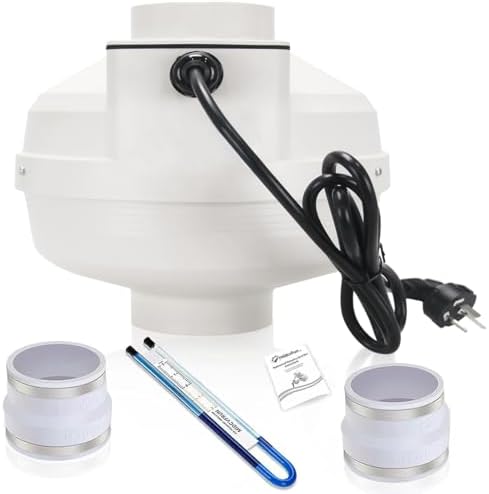
You can view our full Hurricane Inline Fan review for detailed specifications.
Physical installation failures caused by incorrect centrifugal blower sizing
Incorrect sizing also leads to physical installation failures. A blower with a 5.31-inch outlet will not seat correctly into a 4-inch pipe without significant modification or the use of heavy-duty reducers. Using adapters to bridge a large size gap can create additional turbulence and points of failure, potentially leading to air leaks or vibrations that can damage the blower’s bearings over time. If the fit is not precise, the blower may not be able to maintain the static pressure required for the job.
For more details, see our full Fasco 50756-D500 review.
What Should I Do if My Measurement Falls Between Two Sizes?
When your measured pipe diameter falls between two standard sizes, the safest approach is to select the smaller of the two available blower diameters and use a high-quality transition adapter. Selecting the smaller diameter ensures the blower can still produce the necessary pressure to move air through the connection, while the adapter provides the physical bridge to your larger pipe. This maintains the integrity of the connection while allowing the blower to operate within its intended performance curve.
Using larger diameter blowers with transition pieces for high volume
If the system requires a high volume of air and the smaller blower cannot meet the flow requirements, you must choose the larger diameter blower. In this scenario, you will need to install a transition piece that reduces the diameter of the blower’s outlet to match your existing pipe. Because the blower is designed for a larger opening, it will have the power to push air through the reduction, provided the reduction does not create a pressure drop that exceeds the blower’s rated capacity. This is often the preferred method for industrial-scale centrifugal blowers where volume is the priority.
Detailed specifications are available in our full D2E133-AM47-94 Blower review.
Calculating ductwork length and filter resistance to confirm blower diameter
Before making a final decision, confirm the specific requirements of your installation. If you are unsure if a 4-inch or a 5-inch blower will provide enough pressure, calculate the total length of your ductwork and the resistance of your filters. A larger diameter blower is better suited for moving high volumes of air over short distances. If the requirements are truly ambiguous, consult with a qualified HVAC or industrial ventilation technician to ensure the chosen diameter will meet your specific flow needs.
Performance data is available in our full Dayton 1TDR7 review.
What We Know About the Research
The research conducted on the centrifugal blowers we evaluated shows that inlet/outlet diameter is often a variable spec. While several models in our comparison list a median diameter of 4 inches, others offer specific ranges such as 4 to 5.31 inches. We do not have data on the specific friction coefficients of every possible pipe material, so the suitability of a specific diameter depends heavily on your unique ductwork configuration.
Browse our other centrifugal blower pages
- Choosing the Best Centrifugal Blower for Medicine Cabinets
- The Centrifugal Fans That Work Best for 4 Inch Ductwork
- Which Centrifugal Blower Is Best for Low Noise Exhaust?
- Best Centrifugal Fans for Small Spaces
- Home Ventilation Centrifugal Blowers Compared
- Choosing the Best Centrifugal Blower Under $300