
Refrigerant Recovery Pro is reader-supported: some links on this page are affiliate links, and as an Amazon Associate Refrigerant Recovery Pro earns from qualifying purchases at no extra cost to you. Learn more.
Centrifugal blowers are air movers that use a rotating impeller to accelerate air into a high-pressure stream. You need a blower with a specific airflow capacity when the volume of air you move per minute must meet a target, such as 290 CFM. Before choosing a unit, you should measure the total volume of the space you need to ventilate and the resistance of your ductwork to determine the required pressure and flow rates.
To maintain a quiet environment, find the best centrifugal blower for low noise exhaust.
Tight layouts require specific dimensions, so explore the best centrifugal fan for small spaces.
Centrifugal Blower Capability Terms
- Airflow Capacity – This measures the volume of air moved through the system per unit of time, typically in Cubic Feet per Minute (CFM). A higher number indicates the blower can move more air volume, which is necessary for larger rooms or high-volume ventilation.
- Static Pressure – This measures the resistance the fan must overcome to move air through a system, such as through long ducts or filters. You need a higher static pressure rating if your ductwork is long, narrow, or contains restrictive components.
- Rotational Speed – This measures how many full turns the impeller makes every minute, expressed in Revolutions per Minute (RPM). While higher RPM can increase airflow, it often increases noise and may limit the service life of the motor.
- VFD – A Variable Frequency Drive allows for precise flow control and energy savings by adjusting the motor speed based on real-time needs. Using a VFD means you can lower the power draw when maximum airflow is not required.
- Bearing Type – This refers to the mechanism that supports the rotating shaft, such as sleeve or ball bearings. Ball bearings generally offer higher speeds and durability, while sleeve bearings are common in smaller, lower-speed applications.
- Amperage – This measures the electrical current the blower draws from your power source, measured in amps. A higher amperage indicates a more powerful motor that requires a corresponding electrical circuit capacity.
Where these choices show up in our reviews
Each of the 3 shown here has its own full review on this site; they run from $115.45 to $136.76.
For residential projects, compare the best centrifugal blower for home ventilation.
Safety is paramount when installing the best centrifugal fan for radon mitigation.
For hazardous environments, view the best centrifugal blower for laboratory fume hood ventilation.


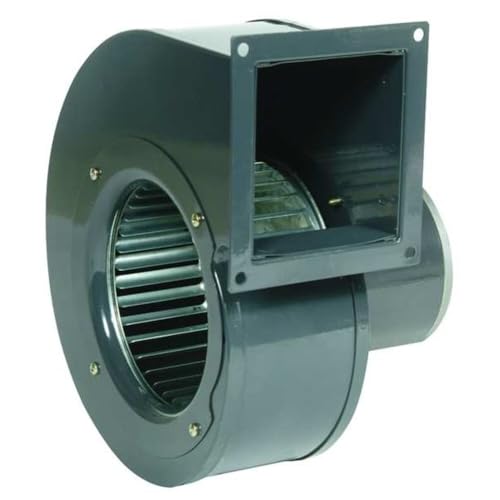
Centrifugal Blower Physical Terms
- Impeller – This is the rotating component that determines the airflow volume and pressure capacity by pushing air outward. The shape and blade pitch of the impeller dictate how much pressure the blower can generate.
- Housing – This is the outer casing that dictates the duct connection size and noise attenuation by containing the air movement. A larger housing often allows for larger inlet and outlet ports.
- Inlet/Outlet Diameter – This measures the physical width of the opening for air entry or exit, usually in inches. You must ensure the diameter matches your existing ductwork to prevent leaks or pressure drops.
- Motor Frame Size – This determines the physical mounting footprint of the motor, affecting how much space you need for installation. Standardized frame sizes ensure that the blower can be bolted to specific industrial mounting plates.
- Voltage – This indicates the electrical requirement of the blower, such as 115V or 230V. You must match the blower’s voltage to your available power supply to avoid damaging the motor.
Centrifugal Blower Compatibility Standards
- NEMA and IEC motor standards – These standards determine electrical compatibility, mounting footprints, and voltage requirements for the motor. Choosing a standard-compliant motor ensures you can find replacement parts and compatible mounting hardware.
- AMCA certification – This provides the industry standard for verified airflow and static pressure performance. Certified units provide data that has been independently verified against the manufacturer’s claims.
- Flexible Ducting – This is a pliable connector that joins the blower to the ventilation system. It allows for slight adjustments in positioning during installation.
- Vibration Isolator – This is a mounting component that reduces structural noise and mechanical wear by absorbing movement. Using an isolator is necessary if the blower is mounted to a wall or ceiling where noise transmission is a concern.
- Belt Guard – This is a safety shield that ensures operator safety during operation by covering moving parts. Most industrial blowers require a guard to meet safety regulations.
Commonly Confused Centrifugal Blower Terms
Many buyers confuse Airflow Capacity with Static Pressure because both are used to describe “power.” Airflow Capacity (CFM) tells you how much air moves, while Static Pressure tells you how hard the blower can push that air against resistance. A blower with high CFM but low static pressure will fail to move air through a long duct run. You must ensure the static pressure meets your ductwork’s resistance requirements even if the CFM meets your volume needs.
For a foundational overview, look at how a centrifugal blower works and what it is.
If these units aren’t right for your project, explore the alternatives to a centrifugal blower.
Protecting your investment is easy once you see what to check in centrifugal blower warranties.
Why airflow depends on impeller design rather than just motor RPM
Another common point of confusion is the difference between the motor’s RPM and the actual airflow. While higher RPM often results in higher airflow, it is not a direct 1:1 calculation because the impeller’s design and the housing’s shape also dictate performance. A slower-spinning blower with a high-efficiency impeller can sometimes move more air than a high-speed blower with a less efficient design. Always prioritize the stated CFM and Static Pressure figures over the RPM when selecting a unit for a specific task.
Proper installation depends on understanding how to choose a motor frame size.
Detailed performance data is available in our full Fasco B24220 spec review.
Find out how it performs in our comparison of the Hurricane Inline Fan.
How matching source voltage to blower power requirements prevents electrical failure
Buyers often confuse the difference between 115V and 230V requirements. A 115V blower is standard for many residential and light commercial outlets, while 230V is common in industrial settings for higher power requirements. Connecting a 230V blower to a 115V circuit will result in a motor that does not start or runs at a fraction of its rated power, while the reverse can cause immediate electrical failure. Always verify your source voltage before ordering.
See our data-driven breakdown in the D2E133-AM47-94 Blower review.
You can see the technical specs in our full review of the Dayton 1TDR7.
Browse our other centrifugal blower pages
- Best Centrifugal Blowers for Laboratory Fume Hood Ventilation
- Radon Mitigation Centrifugal Fans Compared
- Choosing the Best Centrifugal Blower for Medicine Cabinets
- The Centrifugal Fans That Work Best for 4 Inch Ductwork
- Which Centrifugal Blower Is Best for Low Noise Exhaust?
- Best Centrifugal Fans for Small Spaces