
Refrigerant Recovery Pro is reader-supported: some links on this page are affiliate links, and as an Amazon Associate Refrigerant Recovery Pro earns from qualifying purchases at no extra cost to you. Learn more.
Centrifugal blowers come in three main types defined by their airflow capacity: low, medium, and high capacity. You should measure the total volume of the space to be ventilated and the resistance of the ductwork to determine your required airflow capacity.
If you are designing a medical storage area, see our guide to the best centrifugal blower for medicine cabinets.
Centrifugal Blower Types Among the Listings We Screened
| Type | What sets it apart | Listings we screened | Price range | Median airflow capacity |
|---|---|---|---|---|
| Low Capacity Blowers | airflow capacity up to 260 CFM | 3 | $120.49 to $195 | 171 CFM |
| Medium Capacity Blowers | airflow capacity 260 to 1,000 CFM | 3 | $115.45 to $463.21 | 353 CFM |
| High Capacity Blowers | airflow capacity 1,000 CFM and up | 0 | – | – |
Counted over the 8 listings this site screened; a listing that does not state the figure a type is defined by is not counted under any type.
Budget-conscious buyers can find our list for the best centrifugal blower under $300.
Where these choices show up in our reviews
Prices across these 3 run from $120.49 to $195; each one has a full review here.
To ensure your home is safe, compare the best centrifugal fan for radon mitigation.
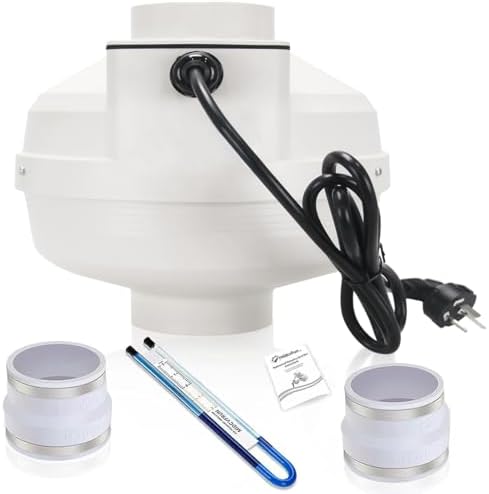


Low capacity blowers move up to 260 CFM of air
Low capacity blowers are defined by an airflow capacity of up to 260 CFM. These units are designed for small-scale ventilation where the volume of air moved per unit of time is relatively low. They perform best in localized applications, such as exhausting fumes from a small workbench or providing air circulation in a compact room. Because they move less air, these blowers typically have lower power requirements and operate at a lower noise level than larger units. They give up the ability to move high volumes of air through long duct runs or heavy-duty filtration systems. These units generally sit at the lower end of the price spectrum relative to medium and high capacity options.
For standard ducting requirements, see the best centrifugal fan for 4 inch ductwork.
When to use low capacity blowers
A buyer requires a low capacity blower when the target area is small and the air path is short. If the ventilation point is within 10 feet of the source and the space is under 200 square feet, these units provide sufficient circulation. Choosing a unit with insufficient airflow for a larger space results in stagnant air and poor ventilation. This occurs when the blower cannot move enough air to replace the volume of air exhausted or consumed by the process.
Safety is paramount, so review the certifications and safety standards for centrifugal blowers.
Medium capacity blowers move between 260 and 1,000 CFM
Medium capacity blowers are defined by an airflow capacity between 260 and 1,000 CFM. These units are for users who need to move significant air volumes, such as in large workshops, commercial kitchens, or industrial drying rooms. They offer a balance of high-volume movement and manageable physical footprints, making them more versatile than low-capacity options. They give up the extreme volume of industrial-scale systems but provide more consistent pressure for moderate duct lengths. These units sit in the middle of the price range, reflecting the increased motor power needed to reach these flow rates.
Beginners can learn about the centrifugal blower explained: what it is and how it works.
Determining medium capacity needs
You need a medium capacity blower if your ventilation requirements exceed 260 CFM but do not require the massive output of a high-capacity industrial system. This is common in scenarios where air must be pushed through several elbows or a medium-length duct run. If the distance from the blower to the exhaust point exceeds 20 feet, a medium capacity unit often provides the necessary pressure to maintain flow. Using a blower that is too small for this volume results in a backup of air at the source, which can lead to heat buildup or poor air quality.
To understand the technical data, view our centrifugal blower terms and specs, explained in plain English.
High capacity blowers move 1,000 CFM or more of air
High capacity blowers are defined by an airflow capacity of 1,000 CFM and up. These units are intended for large-scale industrial applications where massive volumes of air must be moved rapidly. They excel at clearing large warehouses, large-scale manufacturing floors, or heavy industrial exhaust systems. They give up portability and quiet operation, as the high rotational speeds and large impellers required to move this much air generate significant noise and demand substantial power. These units sit at the highest price point in the category.
Selecting the right size is easy when you see how to choose your inlet/outlet diameter for centrifugal blowers.
High capacity blowers for industrial systems exceeding 1,000 CFM
High capacity blowers are required when the project involves moving air through large-scale industrial infrastructure. These are often used in systems where the volume of air moved per unit of time must exceed 1,000 CFM to maintain a safe environment or a specific process temperature. Because of the high output, these units are often the only option for large-scale ventilation where smaller blowers would fail to move air through the system’s resistance.
Ensure proper mounting by learning how to choose your motor frame size for centrifugal blowers.
Centrifugal Blower Type Comparison
| Type | Best-fit buyer | Main advantage | Main compromise |
|---|---|---|---|
| Low Capacity | Small workshop or room | Low noise and power | Limited air volume |
| Medium Capacity | Large workshop or kitchen | Versatile flow range | Higher power draw |
| High Capacity | Industrial warehouse | Massive air volume | High noise and cost |
How do I know which blower type I need?
You know which blower type you need by calculating your required airflow capacity based on the volume of the space and the required air changes per hour. First, measure the length, width, and height of the area to find the total cubic feet. Multiply this by the number of times per hour you need to replace the air to find your total CFM requirement. If your calculated number is under 260, a low capacity blower is the appropriate choice. If it is between 260 and 1,000, a medium capacity blower is required. If it exceeds 1,000, you must move to a high capacity blower.
To optimize performance, see how to choose your rotational speed for centrifugal blowers.
How static pressure affects the required centrifugal blower capacity
A common mistake is choosing a blower based only on CFM without considering the resistance of the ductwork. Static pressure measures the resistance the fan must overcome to move air through a system. If you have long runs, multiple 90-degree elbows, or high-efficiency filters, you must select a blower with a high static pressure rating even if the CFM requirement seems low. A blower with insufficient pressure capacity fails to move air through long runs or restrictive filters, leading to a failure in the ventilation system.
You can see our full Hurricane Inline Fan review to see how it performs.
How do these compare to industrial standards?
The products in this category are often compared against industrial-scale centrifugal blowers, such as those from Greenheck or Cookson, which serve as benchmarks for performance and build quality in large-scale applications. While these industrial-scale units are designed for extreme environments, the blowers evaluated here provide comparable mechanics for smaller commercial and industrial needs. Furthermore, professional standards for precision flow control and energy efficiency are often met by Variable Frequency Drive (VFD) integrated systems. VFD systems allow for the adjustment of rotational speed to match the exact demand of the environment, providing a level of efficiency that fixed-speed blowers cannot match.
Technical details are available in our full Fasco B47120 review.
The role of VFD systems
Variable Frequency Drive (VFD) integrated systems are the professional standard for precision flow control and energy efficiency. By adjusting the speed of the motor, a VFD-equipped blower can match the required airflow capacity exactly, rather than running at full power constantly. This prevents the waste of energy and reduces mechanical wear on the impeller. If your application requires varying air volumes at different times of the day, a VFD system is the standard to look for in the data.
We provide a detailed analysis in our full Fasco 50756-D500 review.