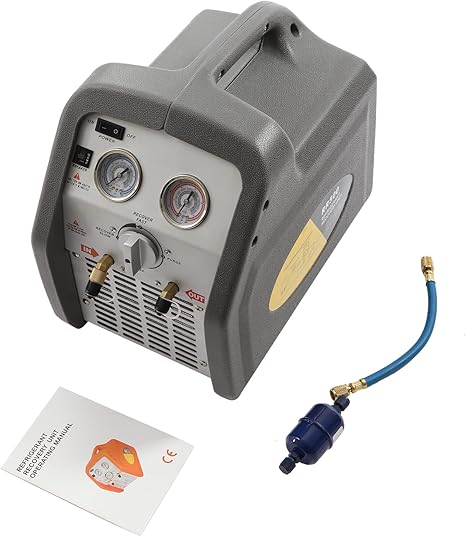
Gdrasuya Gdrasuya10 Two-Cylinder AC Refrigerant Recovery Machine with Filter Hose (110V, 1HP)
Category: Refrigerant Recovery
Check Current PriceChoose the Gdrasuya Gdrasuya10 Two-Cylinder AC Refrigerant Recovery Machine for compact shop recovery. It delivers oil-free, two-cylinder compression and push-pull speed. This tool simplifies Refrigerant Recovery for mobile jobs and bench repairs.
When Small Shops Should Choose the Gdrasuya Gdrasuya10
Small HVAC shops should buy the Gdrasuya Gdrasuya10 Two-Cylinder AC Refrigerant Recovery Machine for efficient, compact recovery. This unit combines 1HP electric power with push-pull, gas and liquid modes for varied jobs. Refrigerant Recovery works faster with oil-free two-cylinder compression and a filter hose. That speed reduces job time and raises daily throughput for a single technician.
What power, battery and inverter specs suit mobile repairs?
Gdrasuya Gdrasuya10 delivers 0.5 kg/min gaseous recovery.
The machine requires a 110V AC supply and 1HP plug-in motor for normal operation. Technicians must plan power for onsite use because the unit is not battery powered. Use a generator or inverter that supplies clean, continuous 110V AC to avoid tripping high-voltage protection circuits.
- Power: 110V AC (electric plug-in)
- Horsepower: 1HP
- Recovery rates: gas 0.5 kg/min, liquid 3.6 kg/min, push-pull 10 kg/min
- Dimensions: 15.75 x 9.84 x 14.17 in (40 x 25 x 36 cm)
- Compression: oil-free two-cylinder
Choose a generator with a continuous AC rating at least 20 above the unit s steady draw. An inverter (device converting DC battery power to AC) must produce a pure sine wave for stable motor performance. These selections prevent overload trips and protect the recovery motor during sustained onsite work.
Assessing power, portability and runtime for onsite jobs
For onsite tasks, the Gdrasuya Gdrasuya10 Two-Cylinder AC Refrigerant Recovery Machine balances power, portability, and runtime. The unit s compact case and handle make transport between rooftops and vans straightforward. Because the model is electric plug-in only, runtime depends on generator or vehicle inverter availability. Understanding portability helps you plan jobs without unexpected downtime.
How much bench space and clearances are needed for onsite use?
Gdrasuya Refrigerant Recovery Machine occupies a compact 15.75×9.84×14.17 inch footprint.
Place the unit on a stable bench that offers a small footprint and secure clamps for hoses. Allow unrestricted air path around the motor to prevent heat buildup and to let the cooling air flow completely. Keep flexible hoses routed without tight bends to preserve filter-hose life and reduce risk of kinking.
- Minimum bench depth: allow at least 6 inches behind unit for hose routing
- Top clearance: recommend 4-8 inches for air circulation over vents
- Front clearance: 6-12 inches for access to switches and filter hose
These clearance guidelines reduce overheating risk and make valve access safe during transfers. If you mount the unit in a service van, secure the handle and block movement to avoid stress on the filter hose and fittings.
Integrating the Gdrasuya Gdrasuya10 into small shop workflows
Start workflow planning around the Gdrasuya Gdrasuya10 Two-Cylinder AC Refrigerant Recovery Machine by defining job steps and consumable swaps. The included filter hose simplifies initial hookups, but you should schedule filter changes between dirty systems to avoid contamination. Track cycle time per job using the unit s liquid and gas modes to forecast daily throughput and labor costing.
Which accessories and attachments best extend small shop productivity?
Gdrasuya10 Refrigerant Recovery Machine (Two-Cylinder) pairs well with a high-capacity recovery tank to speed bulk transfers.
Add the right accessories to reduce hookups, lower leak risk, and speed transfers. The unit ships with a filter hose, but shops expand capability with manifold gauge sets, cylinder gauges, and quick-connect fittings. Use brands and tools known in HVAC service for reliability, for example Robinair vacuum pumps for deep vacuum, Yellow Jacket recovery tanks, and 1/4″ and 3/8″ refrigerant hoses with AN fittings.
- Included: filter hose (improves contamination control)
- Recommended gauge set: 4-valve manifold with 1/4″ and 3/8″ ports
- Suggested vacuum pump: Robinair model 15500 or equivalent
- Recommended recovery tank brands: Yellow Jacket or equivalent rated cylinders
Use a dedicated scale and cylinder log to meet refrigerant tracking rules and to bill accurately by recovered mass. Accessories like quick-disconnects and extra filter hoses reduce dead time between jobs and improve the unit s effective daily capacity.
Common buyer follow-up questions and quick answers
Do I need a generator to run this unit onsite? Yes, a generator or inverter that provides 110V AC is necessary because the unit is plug-in only. Choose a generator rated above the recovery unit s steady draw for headroom. If using an inverter, use a pure sine-wave model to avoid motor issues.
How long to recover a typical 5 lb charge? At the push-pull rate of 10 kg/min the machine can move refrigerant quickly, but site conditions slow transfer. Expect liquid-mode transfers to finish in minutes for small cylinders, while vapor recovery depends on system size and ambient temperature.
Can I use it on R410A and other refrigerants? The Gdrasuya Gdrasuya10 supports gaseous and liquid recovery modes, which suit most common refrigerants such as R410A, R134a, and R22. Verify local regulations, match tank ratings to refrigerant type, and use correct manifold fittings for each refrigerant to comply with safety rules.