
Refrigerant Recovery Pro is reader-supported: some links on this page are affiliate links, and as an Amazon Associate Refrigerant Recovery Pro earns from qualifying purchases at no extra cost to you. Learn more.
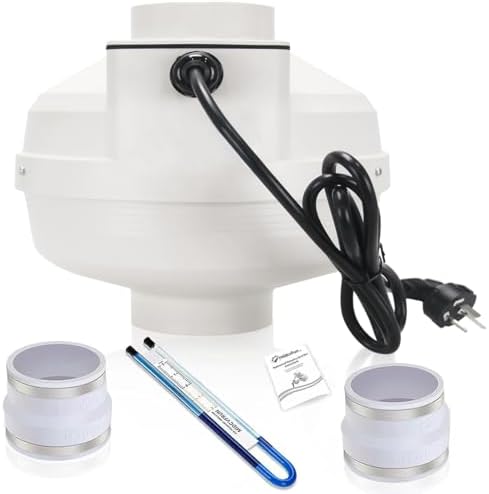
You must measure your total basement square footage and the length of your 4-inch PVC piping—the tubes that carry air out of the house—to ensure the system handles your specific volume and friction loss. Start by confirming your basement’s air exchange rate requirements to see if 260 CFM provides enough turnover for your space.
The 260 CFM radon fan kit provides sufficient sub-slab depressurization
The 260 CFM rating at 45db provides the primary thrust for sub-slab depressurization, which is the process of pulling radon gas from beneath a home’s foundation. We selected the Radon Fan Kit for this comparison because it offers a versatile two-speed motor for different pressure needs. While 260 CFM suffices for a standard basement, it is not enough to provide whole-home ventilation, which typically requires 300 to 600 CFM, or to ventilate a laboratory fume hood requiring 400 to 800 CFM. However, the 188CFM low-speed setting remains sufficient for moving air in a tight crawlspace where 50 to 150 CFM is the standard requirement. Because centrifugal blowers can be choked by high-resistance ducting, you must verify that your basement has a standard seal rather than high-pressure zones that require specialized industrial static pressure—the resistance a fan must overcome to move air through a system.
You can find our final verdict on the MIDCVFRUN Radon Fan Kit performance to see if it meets your airflow needs.
What to Check Before Buying the Radon Fan Kit
Before ordering, verify these physical requirements to ensure the blower performs as expected in your specific environment.
For those concerned about moisture, see if the 4 inch blower has an IP67 rating for outdoor durability.
- Measure the total square footage of the basement to determine if 260 CFM meets your desired air exchange rate.
- Calculate the total length of 4-inch PVC piping to account for friction loss, which reduces the actual CFM delivered at the source.
- Confirm that your basement does not have high-pressure zones that exceed the static pressure capacity of a standard centrifugal fan.
- Identify the specific type of exterior cap needed to prevent backdrafts or pest entry into the vent line.
- Verify that your electrical setup supports the one-click wiring configuration provided in the kit.
Comparing the Radon Fan Kit to Other Options
The Radon Fan Kit serves as a compact, inline centrifugal blower—a motorized unit that pulls air through a pipe and pushes it out of a building. This specific model is ideal for homeowners who need a reliable, sub-slab depressurization solution for a standard residential basement or crawlspace. If you require high-volume airflow for whole-home ventilation or industrial applications like fume hoods, you should look for alternatives with higher CFM ratings that exceed the 300 CFM threshold. Buyers with complex ducting runs or extreme static pressure requirements may also need to consider larger industrial-scale units to prevent the motor from being overwhelmed by resistance.
If you are still deciding on a model, see which centrifugal fans are best for 4 inch ductwork to compare top options.
You should choose the Radon Fan Kit if your project involves a standard basement or crawlspace where 260 CFM provides sufficient airflow for radon mitigation. If your requirements involve high-volume ventilation for a large home or a specialized workspace, look for a higher-capacity system instead.